
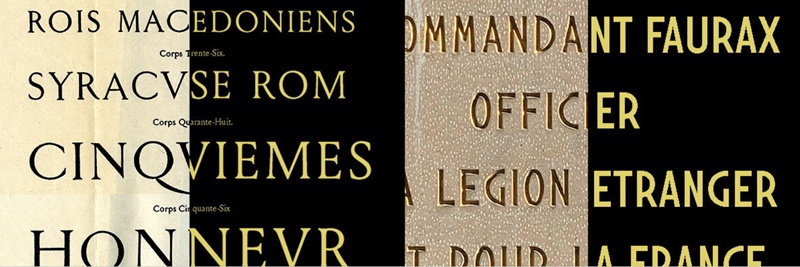
Collage of historical inscriptions and typographic details carved, engraved or printed in serif capital letters. Fragments of French text, including place names, military titles and Roman references, are arranged in vertical panels. The composition highlights the craftsmanship, proportions and material qualities of letterforms through contrasting light and dark backgrounds, showcasing the enduring influence of classical typography and inscriptional lettering.

Herb Lubalin Lecture Series: Carving shapes – Lyons Letterforms, from Stone to Digital

Date: 26 October 2026
Time: 4:30 pm – 6:30 pm
Online via Zoom
Third-party event
Collage of historical inscriptions and typographic details carved, engraved or printed in serif capital letters. Fragments of French text, including place names, military titles and Roman references, are arranged in vertical panels. The composition highlights the craftsmanship, proportions and material qualities of letterforms through contrasting light and dark backgrounds, showcasing the enduring influence of classical typography and inscriptional lettering.

The city of Lyon, in south-eastern France, is home to many carved inscriptions, dating back to its foundation by the Romans in 43 BCE. Living among them, a type designer can hardly remain untouched by these letterforms. This was as true in 1846 as it is today, when Louis Perrin decided to break away from the dominant Didot/Bodoni style of the time and cut a series of Augustaux, one of the first type designs conceived as a ‘revival‘. Originally cut for the book Inscriptions antiques de Lyon, these types helped launch the “Elzevir” movement, which continued to grow throughout the second half of the 19th century.

This talk will take a closer look at Perrin’s model and explain the process behind the design of Louize, itself a revival of Perrin’s revival. The second part of the talk will briefly introduce Molitor, a geometric Art Deco typeface also inspired by Lyon’s stone carvings, but taking a rather different approach to their digital reinterpretation.

[This talk is free-of-charge. Register to reserve your spot.]